• Soul School “lessons” are released each Wednesday (aka “Hump Day” aka Midweek).
• On FRIDAYS I feature guests and on a variety of topics!
Today is a great day to help the show. I need YOU.
HOW FUNDING WORKS: Spark My Muse takes me 25-30 hours per week and costs money out-of-pocket each month to create, produce, and host online. Listeners, like you, give in support to defray the cost so the show can stay alive and well.Thank you for giving.
Soul School “lessons” are released each Wednesday (aka “Hump Day” aka Midweek).
• On FRIDAYS I feature guests and on a variety of topics!
Have you ever had a “pang of awesome” in your chest when you did a good thing? That’s the feeling you get when you help here.
HOW FUNDING WORKS: Spark My Muse takes me 25-30 hours per week and costs money out-of-pocket each month to create, produce, and host online. Listeners, like you, give in support to defray the cost so the show can stay alive and well.Thank you for giving today.
Today is the continuation in a series on ancient wisdom and further reading and reflection on Ecclesiastes. Be sure to listen to all of it and begin with Lesson 50 to listen the whole way through to get the full understanding and depth intended this series.
(Share a piece of audio, if you’d like using the app below.)
• Each FRIDAY I invite guests to have a conversation with me!
• Come back each Wednesday
(on “Hump Day” aka Midweek) for a brief Soul School “lesson”.
HOW FUNDING WORKS: The difficult truth is that even though listening is free, Spark My Muse costs hundreds of dollars out of my own pocket each month to create, produce, and host online–and takes 25-30 hours of work per week to keep it afloat–which keeps me from making income to pay my own normal bills like electricity and water. The good news is that Listenersgive so kindly (at over 3 times the average!!) to support the show–not just because my particular listeners are high-quality people (they are!), but because of that awesome feeling that happens each time we help out someone else when they need it most. $5 or $10 makes a BIG difference – Thank you for helping too!
(Want to have the power to share Peter Rollins audio for yourself? Just use the Clammer app below to select a snippet! Click the red and white logo.)
4:30
Pub culture in Ireland and not running from doubts and pain.
(Repression is the term in psychoanalysis)
Sharing in each other’s suffering.
[ictt-tweet-inline via=””]Parables are a technology that help us look at painful things not directly so we can cultivate a grace in our lives and toward other people.[/ictt-tweet-inline]
(You can instantly tweet this quote above by clicking the blue bird. Look for other blue birds in these show notes.)
9:00
JRR Tolkien Eucatastrophe (a good undoing, like the kind that happen in Fairy Stories)
Irish culture / music / art
The 18 foot woman in a dress at IKON. Ravel and unravel.
13:30 Pete’s Memento Mori
Pete’s Happy Reaper jacket pin
Something to remind you of death.
• Pete’s happy reaper memento mori.
• Lack and nothingness has a painful side but there is a way to find a fuel from it for life and living.
The painters called the Dutch Masters featured a theme: Vanity / futility of life.
Pieter Claesz, “Vanitas” (1630)
The authentic, lively and cohesive pub [juxtaposed with] the vacuous and lonely night club.
HOW FUNDING WORKS:
Spark My Muse is heard in 174 countries! Help out by giving a gift, now and then.
Thank you for ANY amount,even $5 or $10, you can give today.
Genesis and Science speak two different languages.
Medieval Jewish readings of the Genesis story Adam reflects and parallel the story of Israel and paradise land.
Adam as a symbol, theme, or pattern. Be aware of literary structure.
Bible written as thoughtful theology not history (or science). Written as the story of Israel that show their ideology. (and identity)
MIN 13
[ictt-tweet-inline via=””]Literalism is a modernist reading strategy [of the Bible].[/ictt-tweet-inline]
(To share this nifty quote above on TWITTER, it takes 4 seconds. Just click the blue bird icon. And keep your eyeballs open for other easy-to-tweet quotes throughout these show notes.)
Different books of the people (in different eras) adjust and revise other parts of scripture.
[ictt-tweet-inline via=””]I find that the most conservative way of reading the Bible is the most unbiblical.[/ictt-tweet-inline]
MIN 15
Pete, what do you mean by “GOD”? (and how he encounters that in his newest book.)
Using the word “God” is almost lazy.
MIN 19:30
[ictt-tweet-inline via=””]There is no one portrayal of God in the Bible.[/ictt-tweet-inline]
It changes depending on the culture, theology, time, circumstances, and author or authors writing the book. The New Testament comes from the Old Testament trajectory.
MIN 22:00
[In Paul’s letters] Paul [is] trying to make sense of Jesus when it’s a radical departure from Jewish thought.
[The bible is] [T]he development of how humans think about God. The tribal God is warlike [is one example].
[ictt-tweet-inline via=””]The “biblical God” is the God we see through our own lens.[/ictt-tweet-inline]
MIN 25:00
God in our image.
[ictt-tweet-inline via=””]“It’s not just that we use psychology, we ARE psychology.”[/ictt-tweet-inline]
[ictt-tweet-inline via=””]“All theology is psychology and sociology, [because] we are people who live in communities and people with histories.”[/ictt-tweet-inline]
[ictt-tweet-inline via=””]“God allows [God’s] children to tell [God’s] story from where they are from their perspective.”[/ictt-tweet-inline]
Hold with an open fist.
MIN 28:30
The mystery of the Incarnation and how we see the world.
[ictt-tweet-inline via=””]“Jesus is the model and Savior and messy and a 1st century Jewish man.”[/ictt-tweet-inline]
What’s the divine part of Christology?
MIN 32:00
How has Pete’s personal concepts of God have evolved?
My experience of God is not irrelevant and not relegated to just the academic and the life of the modernist mind.
(Eastern) Orthodox “God as Being” (rather than a Being)
When you think of God what do you think of?
God is in you and without God there is nothing. And God is all around you. (New ideas for Pete).
These brief “lessons” are released each Wednesday
(on “Hump Day” aka Midweek).
• Come back FRIDAYS for intriguing guest conversations!
HOW FUNDING WORKS:
Spark My Muse is heard in 159 countries and costs hundreds of dollars out-of-pocket each month to create, produce, and host online. Without help, it will go bye bye. Thank you for ANY amount,even $5 or $10, you can give today.
Scroll down for the AUDIO PLAYER to hear the epsiode.
INTRO:
Today, I share a personal story as springboard for something about compassion offered in context.
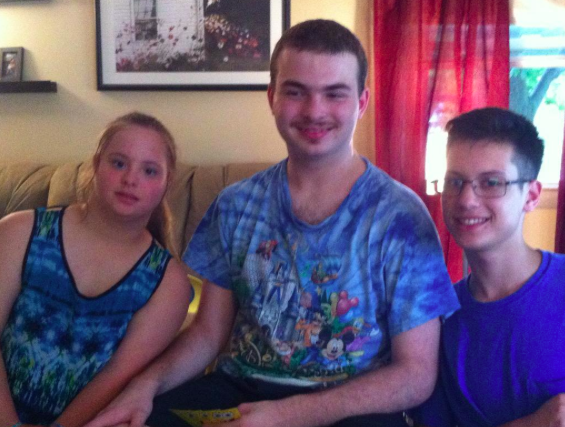
Many of you might not know that my husband and I have a special needs son named Nathan. (We also have a normally-developing daughter named Gabrielle, who we usually call “Ellie”. See photos of both of them below.) It’s been very arduous over the years with Nathan’s myriad of challenges and a strain on the whole family in many ways. To those friends, teachers, family, and others (too many to name) who have been helpful and supportive over the years, we say “thank you”.
What I am sharing today relates mainly to Nathan finding rich connection, friendship, or being truly accepted among his self-identified Christian/church goingpeers. Acceptance is a challenge for many typically developing children and teens. Children and teens by nature are immature, so I don’t (and didn’t) expect things to go perfectly!
His story is far from unique and neither is my pain as his parent watching it unfold. In a Christian setting, we’d like to think that rejection doesn’t happen too much because children might be influenced by church teachings and leadership. Or, Children and teens might be influenced by their Jesus-loving parents to act in ways that loving receive others with equality, but that was not our son’s experience.
When “being a mascot” is the best your child can hope for in terms of acceptance (that is to say that being ostracized is normal and being treated as a ” ‘Hey there little buddy!’ mascot” is a more rare but rather humiliating experience), your context as a family, how you help your child cope, and who shows up as your salvation, can take a surprising turn.
This personal story is the springboard for a deeper reflection today: about how we find our way in the world, make life better for ourselves and others, and maybe find some healing in the process.
What our family’s experiences showed me was that we can provide for others best out of the context from which we come, eventually. Examining those needs, hurts, and context can (possibly) yield a harvest of “good fruit”, eventual healing, and service to others. And maybe (with some new awareness), as we become more mature we can be increasingly mindful to ways we distance ourselves from people we fear. We also distance ourselves from people who unconsciously reflect parts our own weakness or insecurities back to us, and sometimes we distance ourselves from others we deem un-preferred to our sensibilities (or our cultures’ sensibilities) and are unlike us. If we can begin to see this, it’s a start.
• Thanks for listening today! Blessing and peace.
See the show notes below for my two previous fantastic conversations on the theology of disability and hospitality from Dr. Thomas Reynolds. He offers some truly inspiring and enlightening things in these areas that are likely to be completely new ground for you and your community.
AUDIO PLAYER:
(Share a snippet of audio by clicking the Clammr app below. It’s a rock star upgrade!)
Pictured in photo: Nathan, his friend Cori, Nathan’s sister Ellie, and Luna–our dog. A little bit about Nathan: Nathan loves to make videos on his youtube channelabout trains, how-to videos, and animation videos. He loves working at his part-time job (large scale yard work), spending time with friends, making things from soda cans, drawing, playing with Luna, and coming up with fanciful business ideas. He also enjoys posting on his Instagram account. You can follow him on those outlets and encourage him, if you’d like. He loves connecting with new friends and fans. (And if you send him train video footage or interesting video script ideas he might try to create new videos with them.)
Nathan’s video channel trailer:
More on the the study and theology of disability and hospitality.