Listen to the Latest Audio

Why the Body of Christ (people) is Inhospitable to the Disabled

Excerpt from my Book Review Paper of – “Vulnerable Communion: A Theology of Disability and Hospitality”  -by Thomas E. Reynolds

copyright Lisa Colón DeLay © 2010

Caring Stops at Fear

To put it bluntly, the problem lies in the fact that what we hate and fear is personified in a disable person. What we grieve and pity on a grander scale about human existence can be seen in the disabled. What we dread about ourselves, or how the broken world can be, takes on fleshly form, right in front of us, in the acute helplessness of the disabled one.

On a gut level, we realize at some point we too may be helpless and dependent. It seems frightening. We feel weak, inferior, and can be dreadfully aware of our imperfections. We resent being reminded of it. We also fear that grace will not abound for us in these cases. Consequently, we hope the subject does not come up, or that the disabled stay a bit out of view. Disabilities are variations of the vulnerable life that God has given us. They are too, the life he lived out, in human form. It seems a most basic dilemma of human existence is whether there is welcome when it is most needed. Can we can find a safe place to abide, and be with others who recognize us, value us, and empower us to become our best selves. We remain insecure.

Interdependence

Reynolds asserts that the Christian story is, and has been, one of strength coming from weakness, of wholeness emerging from brokenness, and of growth budding from vulnerability. This comes by the grace and almighty power of God. As able-bodied people, we underestimate our need. We admire, idolize, and pursue independence, on all levels.

In contrast, the common good is not achieved unilaterally (individually), or selfishly. The disabled understand experientially what the able-bodied can only know partially, and, by in large, theoretically: we need relationships in order to exist. As we embrace our vulnerability and mature to depend on other, we become more fully human. Weakness, in the interdependence played out as servant host and guest, gives us the privilege of reliance, vulnerability, and the opportunity to pursue abundant life together. It is part of how we develop in trust and faith.

Reynolds delves into theological issues, related to Trinitarian theology. They are discussed in terms of God and his creation, Jesus’ redemption and interaction with humanity, and the Spirit in the context of the Spirit-filled church living as a vulnerable inclusive communion in the redemptive kingdom of God.

Your comments and ideas are encouraged. Please post them.

(Nancy Eiesland) 'The Disabled God' -How do we define "normal"?

In reality, all of us “healthy” or “normal” people can more aptly call ourselves, “the temporarily able-bodied.”

Theologian, sociologist, and author Nancy Eiesland was wheelchair bound since childhood. She surprised many when she said she hoped to be disabled in heaven. She died at age 44 of congenital lung cancer, but not before she made huge inroads for the Rights and Dignity of the Disabled, and penned a groundbreaking book about understanding disability, and suffering, in light of God, and his nature.

Nancy Eiesland 1965-2009

Article excerpt on Eiesland from the “Scotsman” publication:

By the time of her death, Eiesland had come to believe God was disabled, a view she articulated in her influential 1994 book, The Disabled God: Toward a Liberatory Theology of Disability. She pointed to the scene described in Luke 24:36-39 in which the risen Jesus invites his disciples to touch his wounds.

“In presenting his impaired body to his startled friends, the resurrected Jesus is revealed as the disabled God,” she wrote. God remains a God the disabled can identify with, she argued – he is not cured and made whole; his injury is part of him, neither a divine punishment nor an opportunity for healing. FULL ARTICLE HERE

Toward a Liberatory Theology of Disability

God and Disability

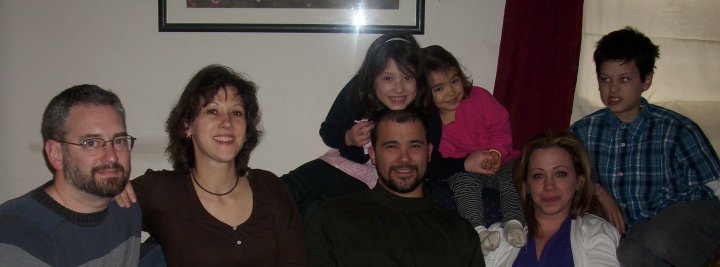
Nathan, like many who experience Autism, often doesn't like having his picture taken. (Later, he saw this photo, and thought it was funny.)

Currently I am taking a rather fascinating class delving into the topic of God and Suffering, called “The Theology of Suffering.” For my final project, I am taking on a specific topic under that category–Disability.

I’m endeavoring to uncover questions like, “Why does God allow children, and adults, to suffer with disabilities?” “Is disability part of God’s plan, or part of what’s broken and wrong in the world?” “What place do the “disabled” have in “God’s Story”?” “How can care-givers of those with disabilities view this type of suffering in light of what God has done, what he is doing, and what he will do?” And some other questions.

In 2001, when my son started to struggle with a rather severe case of regressive autism, I wondered not just what was going on with him, but why? What was the point? I have to say, it all seemed like a mistake. My faith was shaken; not because I thought I should be able to have the child of my dreams, (this was a sad part of it too,) but because seeing my child suffer so badly made me question what God was really like. After a period of grieving, I had to find out more.

Nathan made a paper Nativity set at Christmas

Our son went from meeting all his developmental milestones ahead of time (rolling over, sitting, walking, talking), to not even answering to his own name for days on end, not reacting to pain in any normal way, not speaking to us, and not even calling us “Mommy” and “Daddy” any longer. I didn’t know where to turn, on many levels, and I wondered why God would want to kill me by breaking my heart, day-by-day, as my son sank into frustration, fear, pain, and despair. At times I felt hopeless.

We don’t live near family, and I’d like to say our church, and other Christians, were helpful, but almost no one reached out in any way that was truly or consistently supportive, or meaningful. Experiencing disability and struggle has a way of isolating us, and creating more hopelessness to wade through.

Instead, the opposite can be true. The disabled have much to teach us about hospitality, a characteristic of God, both individually and as a community.

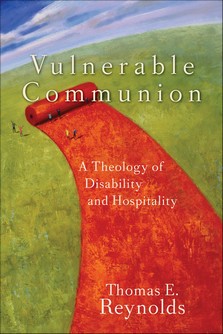
The primary text I’m reading for my research is Vulnerable Communion: A Theology of Disability and Hospitality by Thomas E. Reynolds. What an interesting book!

Vulnerable Communion: A Theology of Disability and Hospitality -Thomas E. Reynolds

Here are a few nuggets I’ve gathered:

• The “disabled” are a picture of human weakness and vulnerability, from which we can learn about the human condition, and God himself. They teach us about the goal of Reliance, versus our misguided and typical goal of “independence.”

• These people are at the center of God’s love, and made in God’s image, they display attributes of God. They help us to see the true nature of God–One who made himself weaker and vulnerable, and still is vulnerable to us. (This vulnerability is epitomized in the historical event, and saving action of Christ’s sacrifice on the Cross at Calvary.)

• The “disabled” give us the opportunity to learn, practice, and experience hospitality, and “do for God” (Matt: 25:40 “And the King will say, ‘I tell you the truth, when you did it to one of the least of these my brothers and sisters, you were doing it to me!”)

This is a topic close to my heart. Uncovering more about it has helped me to not just understand my son, and his struggles better, but to understand God, his character, and his intentions.

Now I’m wondering, “Is it time to write a book on this?”

Please leave your thoughts on this topic, or comment in any way.

May God bless your heart,

Lisa


Spiritual Challenge: A prayer walk.

hiking

Flickr photo from this source.

I’m curious to know if you’ve ever been on a prayer walk? Would you please tell me in the comment section/link below?

The weather (in North America) is changing to mild temperatures, and the beauty of Spring is here.

I’d like to inspire you to carve out 20-45 minutes, (or more, if possible) within the next few days from the time you read this, to absorb the beauty of creation, and the God of it.

This beautiful picture gave me the kick to write this post. Let’s both do it. Go to your calendar now, check for a spot, and mark it down. Morning time, evening, weekend, whatever. You truly have 20 minutes, I know it. Go ahead, I’ll wait. We both know-once you mark it down-it’s quite likely to happen.

With this time, you can allow yourself the experience of a guided prayer walk, using some, or all of the guidelines I’ll lay out below. It will help create a place in your heart to experience the presence of God within and around you. It’s really the perfect Rx for the spring season.

Some suggestions for your walk time:

Items to bring along-

– Comfortable, durable, Shoes

-(if needed) Sunscreen/basic first aid kit

-Water

-Snack

-Notepad and pen

-Camera

(Some of you may want to bring a Bible. If you feel this is important, I am suggesting that you read Scripture before you go on this walk, and if you’d like, bring along a passage, or verse that is on your heart.)

First, allow yourself to acclimate to your environment. Notice your surroundings. Walk deliberately, and also wait, sit or rest, once in a while, and take in your surroundings. Put hurrying aside.

Second, as issues, or chatter run through your mind, push them gently aside, or if they are quite intrusive, jot them down, and give yourself permission to think of them, at another time. (You may may find it helpful to briefly lift those things to God in prayer, and purposefully “hand them over,” before you continue your walk.)

Third, continue until you feel like you’d like to find a comfortable place to sit, or rest, for a little while. The jot down something about your surroundings, and associations that may come to mind about God, and God’s character. Note your response to God, or his creation. Or, record other thoughts you feel are meaningful, or maybe things you would like to explore further, at some point.

Fourth, enter into a time of prayer. It can be any length of time. This is a time of conversation, and also worship. Worship involves  adoration of God. Speak, but also listen.

Fifth, be where you are.

Sixth, Continue your journey until you are ready for it’s conclusion. During this time, you may want to spend more time in prayer, engage in vigorous exercise (walk at a rapid pace, for instance), gaze appreciatively at nature, or sit in quiet, or a bit of each. It’s a free-play, or freeform period of the hike/walk, where you can have all the freedom to enjoy it in the way which makes the most sense for where you are right now in your life. Sense God’s love for you, and his delight in you. If you cannot, ask him for the grace to do so. Forgive others, and forgive yourself.

Seventh, when done, offer a brief prayer of thanksgiving, and accept God’s grace. Receive from God. After a few minutes, write down noteworthy thoughts, experiences, ideas, sensations, or insights that happened along the way, or during your prayers.

Eighth, Later, share some, or all, of your notes with at least one other person.

You may want to walk with another friend, a spouse, or in a small group etc.

How rewarding this is!

For this, I suggest that a period of prayerful silence be observed during the whole time,

and conversations between people be postponed until after the walk is through.

Group discussion after the walk may prove very fruitful.

If you give this a try, I’d love to hear how this goes.

Will you please share your experience here?

(Photos you’ve taken can be sent to ovationeneterprises (at) verizon (dot) net)

May God be with you.

Triple Dog Dare

So, I was thinking….
I have a lot of fun with my blog, but
Do people who want to gear their lives around prayer, also have crazy personalities, and really enjoy a good laugh? (like me) Are these things mutually exclusive? I’m not sure if you’ve noticed, but Christians are not a terribly funny bunch. Okay, let me rephrase that.

Prayerful Christians are usually on the serious side. No, not all, but plenty of them.

I realize I fall into a very narrow minority. I’m an odd mix of God-aware and straight off the silly truck.

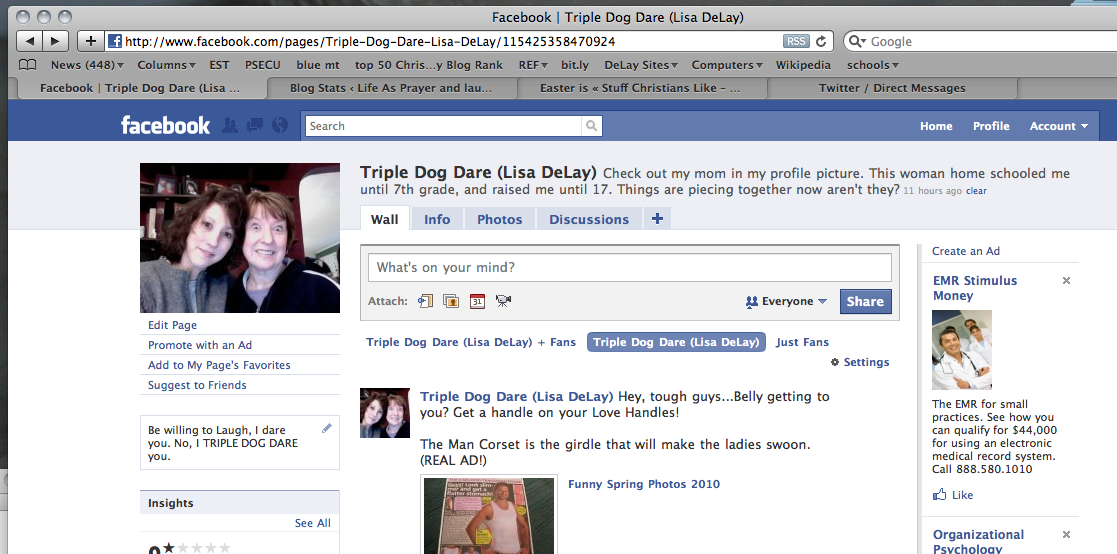
This is where Triple Dog Dare comes in.
You would not believe how hard it is to start the ball rolling to get people unified and interested in prayer, but humor? That covers a lot of people. It’s transcends culture, geography, age, and clothing preferences.

On Facebook, I’ve started a page, and I’m letting out all the stops. That’s some kind of euphemism for going hog wild, which is something hogs do all the time when they aren’t laying around in a contemplative fashion in the soil.

Triple Dog Dare is about having fun, sharing humor, and enjoying a great time laughing. “Killjoy” is never an adjective used to describe me. I’ll be posting a lot of photos that are ridiculous and comedic or ludicrous (or other things described with the endings of “ous”)- and stuff that probably doesn’t fit the theme here so perfectly. (It’s possible that I pushed it with the Crucifixion Pastry. For some reason some in the lesbian community really enjoyed that one, but I still don’t get why. oh well.) I’ll be sharing the tid bits of my ordinary life that somehow have a way of being extraordinary bizarre (in a good way), and hilarious. Won’t you please join me?

Why did I call it Triple Dog Dare?
If you’ve ever seen the movie “A Christmas Story,” it’ll make sense. See if this link to the video clip works. About once a week, I’ll Triple Dog Dare fans with some creative jape. Then we’ll see what results, hopefully in video, photos, and tales of adventure.

Will this blog get more serious? I have to admit, I have not a clue. It may get more focused, but I see some intertwining as a distinct possibility. Let’s see this new extension as all part of organic growth. I have an overactive Muse.
So-Click & link up as a Facebook fan, and let’s get started!


Triple Dog Dare page (facebook)


Random question:
Which do you usually prefer laughing or praying?
Have you ever done both at once? If so, explain :)