Vocation

The Spirit of Lord is upon me, because he has anointed me

to preach the good news to the poor.

He has sent me to proclaim freedom for the prisoners,

and recovery of sight for the blind,

to release the oppressed,

to proclaim the year of the Lord’s favor.

-Lk. 4:18-19

How do we decide things?

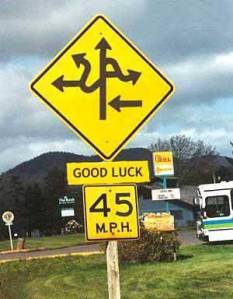
funny_road_signMany of us weigh the decisions we make against the consequences that may happen. For instance, a financially desperate person might say, “I need money, but if I rob a bank, I’ll surely get caught.” A person with a more developed sense of morality may instead reason, “I need money, but that money is not mine to take.” Either way, some kind of assessment of right and wrong takes place, or at the very least pragmatics, which is the determined usefulness, or useful outcome of a particular action (like robbing a bank.)

Pragmatics gets down into the everyday choices, and can be the default setting for our choices. It’s like a common denominator. But really it’s not very good ethics that drives those kinds of decisions. Instead it is only the perceived consequences at the wheel, steering the choice. While it may seem practical to decide something based on whether it will help or hurt, or be useful or not useful, there is a glaring flaw in this method.

What is it? Simply put, we can never truly know the actual consequences of our choices, or their ramifications which lay in the future. What may seem helpful, can hurt many, instead of help. Or, sometimes certain people are helped, while others suffer greatly. History is quite full of these sorts of examples, and we continue to repeat them.

We can abandon a foundation of pragmatics, (the consequential, illogical, ad hoc reasoning method of decision making) by choosing from an altogether better starting point. God. It sounds so simple, but I will not say it is. But, what I refer to is the ultimate ideal, outside ourself–perfection. (Think: Socrates’ model)

The reference of God “himself,” and the nature and Standard of our best choices actually resides in and with God. The best values, the best and most perfect way–that is the way of God. More than that, it is how reality is grounded. God is the ultimate reality. Yes, we won’t measure up. In about two seconds we won’t, to be honest. However, this is not the reason to head for pragmatics, and assume The Good is not possible, a worthy choice, or viable for a standard–or at least the aim, of our own choices. It is the goal of each of us to decide to not choose for ourselves, or for the consequence alone, but for what is the ultimate Good.

Weigh-in with your take, or insights. I realize this particular post is a lofty one. Yes, and idealistic!

ALSO-Please help me spread the word about this website. I would love to have more regular readers. Many thanks to those who’ve read today!

(reader response) Doing what you don't want to do

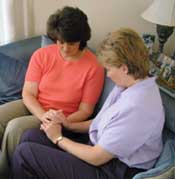
WomenPrayingCouch


Here is a response from Veronica:

I’m glad to come to your site, and start thinking more seriously about my own spiritual growth. I want to keep it in the front of my mind. Well, I guess you could say, I want to “make the main thing the Main Thing.” Wasn’t that a catch phrase once?  I get together with a friend to pray, and keep accountable spiritually. Last week we started talking about having trouble with doing the things we are trying so hard not to do. Really, it’s like how Paul says it in Romans-

Romans 7:19 “I want to do what is good, but I don’t. I don’t want to do what is wrong, but I do it anyway.”

For me, it’s pride. As I start to work on it, I basically get puffed up as I feel I have a handle on it. I catch myself in false modesty with others too. So, really it’s a step backwards. I’m doing what I don’t want to do.

For my friend, she says she struggles with keeping on a good face for show, or pretense. She feels like a fake. She says the more she tries to not put up a front, the more she feels that is exactly what is happening. She is even more conscious of herself, and in the end is more phony. Maybe it has to do with self absorption. Do other people feel this way? Do you have any suggestions? 

Thanks for allowing me to post this Veronica. I can’t say with 100% certainty, but I think what you reveal is quite a common situation. And perhaps you’re right. We might be worse off as we focus on our problem (as you say, self-absorption) rather than pour our adoration into God, follow him, and really turn to him and trust him to make us more like him. Doing what we don’t want to do proves our desperate need for total dependency on God. The more we struggle to do better, the more we’ll find we come up short. I believe relinquishing our control of our own sanctification process (the development of our godly character) is something that is necessary to have freedom, enjoy God’s love, and progress toward the likeness of our Redeemer. It isn’t something we can ever manage, or do well our selves. For me, it is a continual surrendering/yielding process where I humble my will, and heart to God, and give God the timetable for my character restoration, as I recommit to participate fully in his process. (It has to be continual, because I don’t do well for very long!)

Anybody else have suggestions for Veronica?

School Project with tough questions for the church

shepherdI have lots of questions rolling around in my mind right now because of school. My project is to interview 2 leaders from two ministries or churches to find out how they approach spiritual formation/education in their contexts and among their community of believers. The questions are penetrating. Here are just a few:

“In what ways are the sacraments given or experienced that allow for a time of repentance and receiving from God?”

“How is spiritual remembering practiced, and the spiritual disciplines conveyed and taught that will help others imitate the life of Jesus.”

“How well are people able to share their brokenness, (addictions, temptations, grief, etc.) and able to begin healing within the body of believers?”

“Are new believers provided with guides and mentors?”

“How is corporate prayer accomplished to engender brokenness, recompense, transformation, and worship?”


How might your church do with these tough questions? (anonymous posts are fine)

Why does embrace mean so much?

When I first saw this video below, I cried. [youtube=http://www.youtube.com/watch?v=vr3x_RRJdd4]

It showed me the power of offering connection and love. The largely untapped, healing power of embrace–which connotes acceptance–seems to be too absent today. The distance between us grows, even though technology has supposedly drawn us together.

Luke 15:20 “So he returned home to his father. And while he was still a long way off, his father saw him coming. Filled with love and compassion, he ran to his son, embraced him, and kissed him.”

If you would, please response here, and explain your feelings about embrace, or any reactions you had to this post, the video, or the artwork. Thank you.

An idea for plumbing deeper:

Your challenge-

Bring these pictures to mind the next time you pray, and speak about them to God, honestly. If you have fears, joy, sorrow, gratitude, or other feelings, express them, using this theme as a vehicle to interact in your next intimate time with the Lover of your soul.