…especially when we’re talking about humor related to contrasts in size. Behold the giant characters of the roadsides!
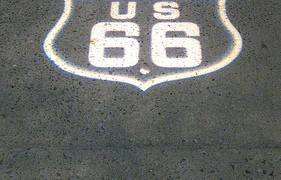
It seems Route 66 is dotted with a few more giant roadside characters per mile than other travel routes. Here are just 3:
(the one on the right isn't doing sign language for "day". He's a lumberjack who used to hold an axe)
But, you know what?
It’s not just route 66 with these attractions. America’s byways have lots of them…and really people in places all over the world create outlandish sights to attract attention or visitors.
Does anything else really say, “Buy stuff here!” as well as an oversized lumberjack with an axe?
In my area, this enormous Amish couple sits outside the famed Roadside America. Actually, they sort of frighten me.
What’s the craziest roadside creation you’ve seen?
Now for some spiritual reflection:
If someone was building a giant something to represent your personality, what would it look like?
I’ve decided to learn a lot more about the road termed “The Mother Road”…Route 66.
Along the way, I’ll post interesting sights from my findings, and I’ll also parallel this excursion to the one we take in our heart, toward God.
You see, no one needs to take Route 66. Faster, smoother, and bigger interstate highways make this route outmoded. No, folks get their kicks on Route 66 for the journey itself…to experience the epic route that is America’s most famous and alluring roadway westward.
Route 66, Chicago, IL
The picturesque course was established in 1926, and originally ran from Chicago, Illinois, through Missouri, Kansas, Oklahoma, Texas, New Mexico, Arizona, and California, before ending at Los Angeles. It covered a total of 2,448 miles (3,940 km).
During the Dust Bowl days, in the early 1930s, people packed up and took this road to make a better life for themselves. In the 1950s, a trip on route 66 was a common family vacation, filled with plenty of sights, shops, roadside attractions, eating establishments, camping grounds, gas stations, and lodging choices. A virtual monument to Americana and campy kitsch. Now the trail ends in Santa Monica, CA, and parts of the old route have been long abandon or fallen into disrepair.
Still the mystique and history of the open road west continues to excite travelers to venture on various portions of the legendary Route 66.
Starting April 3, 2011, I will be teaching a class fashioned after this type of adventure, at Bethesda EC Church, called: Route 66: Adventures in Spiritual Formation. Part I will include getting familiar with the route and its ways: the epic trail God has in store for each of us. Part II will involve the experience of traveling it for ourselves. Two 6-week bursts. I hope you can come.
Various postings here will serve as a companion to the weekly excursions we will take…like postcards and journal entries from highlights and stops on the road.
So, Hop in. During April, May, and June, get hip to this timely tip, and we’ll find some kicks on route 6-6.
Now a question for you: What’s the best road trip you’ve ever taken?
About five years ago, we had neighbors living on our south side. The mister of the family was a truck driver, and one day he found a strange dog at the rest stop and brought him home.
They told me, “Don’t let your children go near our dog, he bites.” The dog was red, fierce, and usually bristling or barking. They kept him in a pen in the back yard.
One day, I saw him playing in his pen. He was pouncing with his front paws on a squeaky toy about the size of a man’s shoe, and having the time of his life. He’d bite the toy, and it would squeak, then he would toss it in the air, and continue playing. I stared at him for a while.
Then, he threw the squeaky toy high in the air, it hit the ground…and ran. It ran squeaking. He pounced again, and started biting. It was a rat. A half-dead rat. Very shocking!
So, you tell, me, what would be a good moral of this story?
What is the strangest thing you’ve seen a pet play with?
Cuss / noun 1 an annoying or stubborn person or animal : he was certainly an unsociable cuss. 2 another term for curse (sense 2).
Disclaimer: I’m not using a moral arguement against cussing, though you might expect I would, at a site with spiritual flavor like this one. While, many may say it’s a sin to cuss, I think what may be the truest thing is that the intention of using the vulgarity that is the real issue at stake. Nevertheless, I won’t go in that direction. My contentions are not nearly so deep or heartfelt. This is simple practicality and common sense at work:
Simply put: I don’t think foul language is powerful enough. I finding it lacking. Any great use of the stuff tips me off that I’m in the company of communication amateurs.
In truth, I’m not very offended by expletives. The shock wore off in high school. And high school–childhood–is about the only time a certain amount of cussing is, sort of, understandable. By nature, kids don’t know how to express themselves very well. Salty language makes rookie humans feel older and more formidable. It gives them a sense of power, as they flex their ” ‘I’m growing up’ muscles”. Yet, it’s the running myth that if something is bleeped on tv, it resides in the realm of “grown-up language”, and signifies something more heady and legit. In fact, expletives are quite banal.
I cuss quite rarely, and when I do it’s actually because I’m having trouble expressing myself. In some foolish desperation I concede to inferior “describing words”. So, really, cussing takes away from our points, rather than aids them.
Just for the sake of developing better communication, we needn’t use them. Maybe you enjoy tossing around a swear here or there. I don’t really care. But here are 7 points to remember on this topic:
7 Cussing Tip Offs
misnamed swear tin (for keeping fines)
1. Cussing quickly reveals one has a diminished vocabulary or the inability to use their vocabulary very well. (This can become a worsening habit also. Hence, it is sometimes combated with a Swear (fine) Bank.)
2. It displays a rather uncreative mind. (What could help? Simple: A thesaurus.)
3. If a cuss word can be used as an adjective, noun, and verb, it’s hackneyed, and by consequence, impotent. Let’s just say it’s, “lame” in a hobbling sense.
4. While cussing may somehow help one reveal emotions, or relieve stress, it doesn’t help one’s case. Quite the opposite. Logic is a better choice. Give it a try.
5. Foul language tells a bigger story about the person and his/her hang ups than it does about whatever the person is trying to convey. (It’s sort of sad, really.)
6. Cussing offends people for a myriad of reasons, but strangely enough, much use of it boils down to spotlighting simple bad manners and poor taste. Throughout history, “vulgar” language has some sort of reflection on social or economic status. [Ex: A mother says to her child who has been running around with the kids from “the other side of the tracks”, “No, honey, we don’t talk like that (or them).”] Most often people mentally associate foul language with an uncouth boorish social class, or uneducated and unrefined upbringing.
7. “Dirty words” are given meaning by a culture, not the other way around. What is the massively cussing person trying to prove, then? And why? [That’s the bigger question.] Here, subtext trumps communication. so probably a #fail
What are your thoughts?
My favorite cuss quote:
“Are you cussing with me?” -Fantastic Mr. Fox