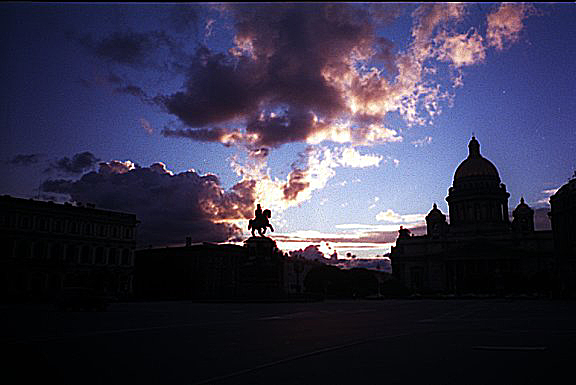
photo/link by Rolf Potts. (St. Petersburg, Russia Midnight sunset near Nevskii Prospect)
(I’ll be a professorial substitute on Thursday, and I’m really looking forward to it. Below is the prayer from Dr. Laurie Mellinger’s lesson plan for that night. It’s the Benediction Prayer.)
I post it today for your personal reflection. Sometimes we don’t make the time to collect ourselves this way. Here’s a our chance today. Maybe it’s also something you’d like to share with someone else.
when I first saw this image called “No Appointment Necessary” I threw up a little in my mouth.
Shortly after pondering that, I laughed my butt off at the lunacy of it all. It’s probably that smoldering look in sexy Jesus’ eye that tickles me. This hunky American Jesus is totally peacockin’! If you’ve got it, flaunt it, right, JC?
If you’re wondering where the Holy Spirit is, I proposed that he’s in Jesus’ hair.
BTW. Wicked hot triceps, Jesus. I mean, Steve. Yes, we noticed!
(Hey friends, if you think THIS Jesus is hot, wait until you see him in, the Sabbath, painting. He’s reclined and “resting”. Right. He looks like he’s waiting for, oh, well never mind.)
Steve has also painted Jesus as a super buff boxer at least four times. Round 15 is the sexiest I’ve seen of that series. (And his hair is crazy gorgeous, like Jesus uses Wen shampoo.)
One of the more awkward ones, is Fireman’s Prayer, Jesus is tucked in close behind a firefighter, and helping him, by holding his hose. And No, I did not make that up.
I thought I didn’t like Thomas Kinkade. But, Steve, you kick his buttocks.
If you don’t like this art, does it mean you don’t like Jesus?
Did anyone ever tell Steve that Jesus was not attractive?
Isaiah 53:2 (prophecy fulfilled)
He grew up like a small plant before the Lord,
like a root growing in a dry land.
He had no special beauty or form to make us notice him;
there was nothing in his appearance to make us desire him.
What if you got a tattoo of this picture of Jesus with a tattoo?
We don’t just have upon us a crisis of faith, but also a crisis of faithfulness.
We’ve been reviewing Francis Chan’s book Crazy Love. I encourage everyone to read it. It’ll do you good. Also, it makes an interesting and thought-provoking small group study, or Sunday School class.
"Crazy Love" by Francis Chan
This last lesson was on Risk and Faith. Chan asked everyone to do something in their regular life that requires faith. He asked that we abandon the typical planning we do to minimize our risk. We should do something others could think of as silly, and allow ourselves to live and act in a more vulnerable way. We shouldn’t rely in our stuff to satisfy us. We should live bigger lives.
Along the same lines, Rolf Potts leads this sort of recommended simpler type of lifestyle. He calls it vagabonding. (I found out about Rolf through the Tim Ferriss site. Thank you, Tim.)For Potts, a travel writer, his style is not just a method of travel, but a way of life. It’s unlike the American way of life, because it does not trust in stuff.
I’ve wondered if it’s the case that in America we seem to act like “in god we trust” refers to the money itself, or the things we can buy with it.
We do a lot to feel safe. We buy insurance to minimize various kind of threats. We buy things we feel sure will help us, or at least soothe us. What is the lasting consequence of this approach? A false sense of control? Feathering our pillow of self-sufficiency? Other things…
Rolf Potts takes the theme of traveling light to a whole new level, as he now begins hisNo Baggage Challenge: Traveling to 12 countries in 6 weeks—With NO baggage (not even a man purse/satchel). [His blog details his travels, and his packing techniques are also quite useful.]
The journey of faith is the same way. When we seek out the comfortable, and we travel heavy, by preparing (mentally or physically) for every potential event, challenge, or threat–something important gets left behind. Perspective for one thing. But what else?
In the life of faith, “taking nothing for the journey” means that one must trust in God’s provision (and hisway of providing), trust others, and build relationships. It’s not about what we’ve packed (prepared) for, it’s about the trip itself. It’s about being brave, and opening up to others, and the experience of not being weighted down (both literally and figuratively) by our presuppositions: What we think the trip should look like, and feel like.
You don’t like bumps, you say? Sorry, it’s bumpy. You just might have been insulating yourself. For some perspective… Think: padded cell.
The spiritual journey (journey of faith) is undertaken so optimal preparedness is removed as an option: It’s a method of living, not to be comfortable, but to survive, live, and eventually thrive, where you are, as you are. You come as you are. When the going gets tough–and it will–you stay. [The only thing you “plan on” is love and loyalty.] You work it out. You don’t let yourself have but that choice. You live has though you don’t have a chance/option to flee–like we are too often ready to do. We trust others, and God with abandon, despite the risks, or pain that may/will come.
Why? Because it is the surest way to growth, more rewarding experiences, and a sense of being in a Story bigger than yourself and your self interests. In spending ourselves, we gain our lives.
When we take a risk to help or love (without examining the our potential losses, and assessing all the personal risks) we live by and in faith, not by sight.
[Now, realize, I’m not talking about a life of folly, or veritable reckless behavior. I’m talking about being okay with discomfort, and sacrificing the known and manageable, for something greater at stake.]
What could that look like for you? Please-Leave your ideas.
Maybe giving away the extra car to someone who needs it? Opening up your home for someone else to live in? Inviting a family to your home for supper once a week? Using a paycheck to buy someone groceries?
What kind of faith will you live by?
In this sense, a little pain goes a long way. Soon, our sights move away from ourselves in pursing selfless faithfulness.
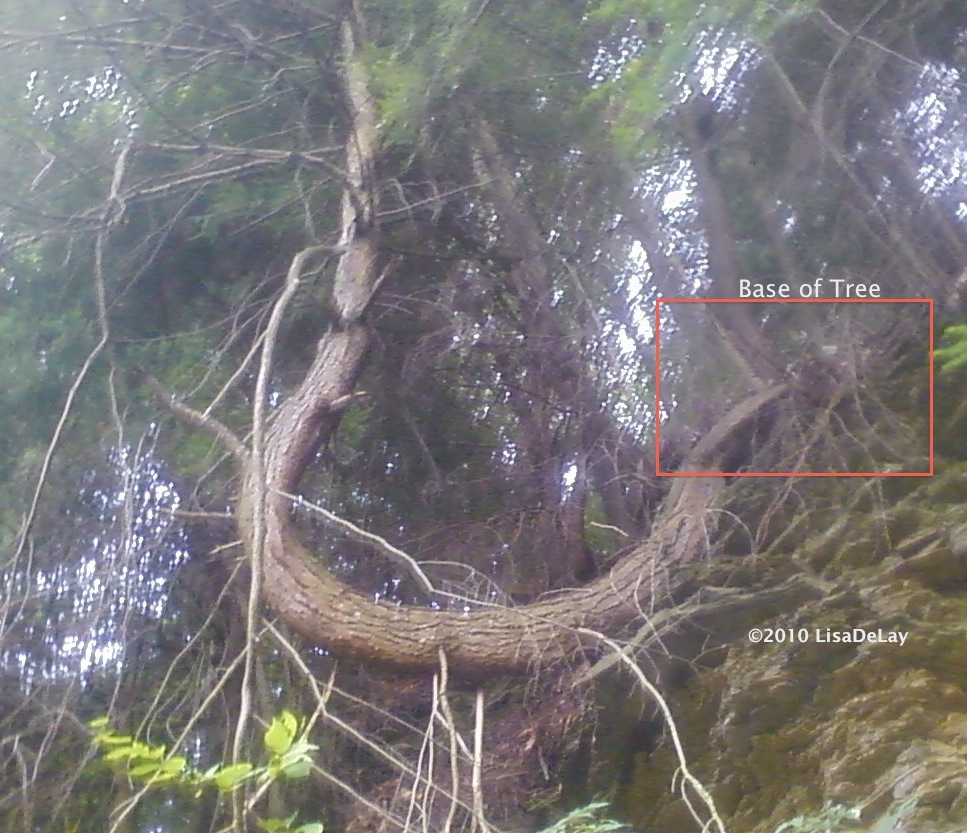
Yesterday, we took this photo on a cell phone at Duff Park in Murrysville, PA. [I apologize for the low quality.]
I really wanted to share this because the image is a fantastic visual example of survival. Look carefully. The red square shows where the tree started. Perhaps some rocks gave way underneath it. Has that ever happened to you?
It seems that for some time the tree was pointed down, away from live-giving sunlight.
But what happened after years of struggle and persistence?
Growth. Survival. Resilience. Vigor. A Healthy (though precariously placed) Tree.
How can you survive when the bottom drops out? Grow up. :)
"I will survive," said the tree.
My prayer of thanksgiving: God, thank you for this example and inspiration from your created world.
I have to do a post about this, esp since it’s fresh in my mind. This morning I had really vibrant lucid dreams. That is, I woke up within the dream, and could control the things I did/decided, and I could consciously control some of the dream’s outcome.
I used to have insomnia as a tween (pre-teen, ages 9-12) and teen. Now, I have trained my mind to fall asleep in usually under 2 minutes. (Much to the astonishment of my spouse, and friends who happen to see it take place.) I usually remember 3-7 dreams per night. I dont’ bother with a dream journal much, because I don’t have several hours to take it all down when I wake up.
If I can’t fall asleep in 5 minutes or less, I tend to be awake for a while. So, I’ve developed some skills to fall asleep. The one I use the most, and the most effectively is counted down from 100. I concentrate on the numbers (number shape and order themselves), and allow my breathing to grow slow and deep. Often I beginning dreaming immediately as I drift off into unconsciousness.
A person can develop this sort of (lucid) dreaming as a skill, much like training yourself to remember dreams. Here are some tips to start remembering your dreams. I also got some quite handy tips on how to wake up a bit better within my dreams fromTim Ferriss, who has researched it a bit.
For me personally, I’ve always had a vivid imagination, been highly creative, and highly stimulated visually. I had always thought everyone had the chance to dream this way. Since I was a little girl I’ve had fantastic lucid dreams, and I would pick *flying* when I would wake in my dreams. This just seemed like the most fun and exhilarating choice, and crashing didn’t happen too often either. (It’s more like bouncing usually.)