Conversing with Fear and Desire [SSL69]

Another Wednesday Audio delivery!

This is Soul School Lesson 69 (SSL 69)


• Be an influencer and share this episode!

 Send out a Tweet-just like magic.
Just click below:

[ictt-tweet-blockquote]I found a NEW audio episode at Spark My Muse -I think you should check it out![/ictt-tweet-blockquote]


Please enjoy the program.
If you’d like to give a gift to help the show, you can use the PayPal button below.
Thank you.

paypal


Click HERE for a SHOW NOTES monthly ACCESS PASS.

Today the show notes will give you details about Atheism for Lent and other info mentioned in the show.  PLUS all past SHOW NOTES and SHOW NOTES for February 2017.
(Fear feature photo by Noemî Galera)

(It’s just $1 -monthly- cancel any time.)


AUDIO PLAYER:


 If you like the show, please share it with one other person TODAY, OR write a review on iTunes. Here’s a short how-to video.


Listen to recent episodes:


Pick an option that works best for you!

Eps 59: Desire and Rhythm of Life – Return Guest Shane Tucker


On Sunday April 24 Spark My Muse will be 1 year old!
HOORAY!
Thank you to everyone who has helped by listening, with encouragement, and with gifts to keep the Spark My Muse show going.bestcake

To celebrate there will be some very interesting things happening in the….
#weekofSPARKle —stay tuned!

Want to send a small birthday gift?
Click to give, the baby Spark a present.


 Today, I have a return guest!
My soul friend, Shane Tucker.
He has a new book and you can get it free.
Today we converse about it and Irish culture
–two fire-makers are sparking things…what’s not to love?

Scroll down for essential links and show notes.

Shane-@-Ross-2012-M


SHOW NOTES

MIN 1

Shane is an Anglican Priest and Soul Friend – a fire-maker of souls – sparking fire for souls!

“Being a best friend you’ve always wanted.”

• Link to my 1st episode with Shane (if you haven’t heard it yet)

Rhythm of Life book link

Intersection of Arts, Faith and Culture

MIN 5

Dreamers of the Day

MIN 6:30

Classic Principles (walk with me)

Poverty, Chastity, and Obedience

MIN 9:30

Distinctive Practices (work with me)

Two Distinct calls of Jesus:

Walk with me & Work with me

MIN 12:00

Photography in the book

and introspective questions within the book

Stirring desire which is fuel for the journey.

The good, the true, and the beautiful

MIN 15:30

Selfish or corrupted life practices

Dallas Willard

VIM

• Vision

• Intention

• Means (resources and tools -practices and disciplines/space makers for God to rush in)

The process of transformation.

MIN 19

Abundant life and freedom

MIN 20

Offering what little we have up to God and into the world.

MIN 22

Dream Out Loud (book)

…is about the 2nd call on our lives building for the Kingdom of God.

Ode by Arthur O’Shaughnessy

Ode

We are the music makers,

And we are the dreamer of dreams,

Wandering by lone sea-breakers,

And sitting by desolate streams;

World-losers and world-forsakers,


On whom the pale moon gleams:

Yet we are the movers and shakers

Of the world for ever, it seems.

With wonderful deathless ditties,

We build up the world’s great cities,


And out of a fabulous story

We fashion an empire’s glory:

One man with a dream, at pleasure,

Shall go forth and conquer a crown;

And three with a new song’s measure

Can trample an empire down.


We, in the ages lying

In the buried past of earth,

Built Nineveh with our sighing,

And Babel itself with our mirth;

And o’erthrew them with prophesying

To the old of the new world’s worth;

For each age is a dream that is dying,

Or one that is coming to birth.


A breath of our inspiration

Is the life of each generation;

A wondrous thing of our dreaming

Unearthly, impossible seeming —

The soldier, the king, and the peasant

Are working together in one,

Till our dream shall become their present,

And their work in the world be done.


They had no vision amazing

Of the goodly house they are raising;

They had no divine foreshowing

Of the land to which they are going:

But on one man’s soul it hath broken,

A light that doth not depart;

And his look, or a word he hath spoken,


Wrought flame in another man’s heart.

And therefore to-day is thrilling

With a past day’s late fulfilling;

And the multitudes are enlisted

In the faith that their fathers resisted,


And, scorning the dream of to-morrow,

Are bringing to pass, as they may,

In the world, for its joy or its sorrow,

The dream that was scorned yesterday.

But we, with our dreaming and singing,

Ceaseless and sorrowless we!

The glory about us clinging


Of the glorious futures we see,

Our souls with high music ringing:

O men! it must ever be

That we dwell, in our dreaming and singing,

A little apart from ye.

For we are afar with the dawning


And the suns that are not yet high,

And out of the infinite morning

Intrepid you hear us cry —

How, spite of your human scorning,

Once more God’s future draws nigh,

And already goes forth the warning

That ye of the past must die.


Great hail! we cry to the comers

From the dazzling unknown shore;

Bring us hither your sun and your summers;

And renew our world as of yore;

You shall teach us your song’s new numbers,

And things that we dreamed not before:

Yea, in spite of a dreamer who slumbers,

And a singer who sings no more.


A wondrous thing of our dreaming,

Unearthly, impossible seeming-

The soldier, the king, and the peasant

Are working together in one,

Till our dream shall become their present,

And their work in the world be done.


And therefore today is thrilling,

With a past day’s late fulfilling.

And the multitudes are enlisted

In the faith that their fathers resisted,

And, scorning the dream of tomorrow,

Are bringing to pass, as they may,

In the world, for it’s joy or it’s sorrow,

The dream that was scorned yesterday.


For we are afar with the dawning

And the suns that are not yet high,

And out of the infinite morning

Intrepid you hear us cry-

How, spite of your human scorning,

Once more God’s future draws nigh,

And already goes forth the warning

That ye of the past must die.


Great hail! we cry to the corners

From the dazzling unknown shore;

Bring us hither your sun and your summers,

And renew our world as of yore;

You shall teach us your song’s new numbers,

And things that we dreamt not before;

Yea, in spite of a dreamer who slumbers,

And a singer who sings no more.


MIN 25:30

The book title’s connection to the band U2

Streets Have No Name

Always

MIN 27

Hope in Irish culture and in the music. The folk music expresses sadness and joy together.

MIN 29:30

JRR TOLKEIN

eucatastrophe 

“ a good undoing”

a joy that brings tears–a sudden glimpse of truth.

MIN 32

The Trips Shane Guides to Ireland

Featuring ancients stories, heroes, and revered saints, landmarks, pubs, and historic features.
Find Shane on Twitter:

@dreamingbig

His website: artistsoulfriend.com

Episode 9 – Wine: moderation vs. medication (The famous HALT method)

Shownotes:
Spark My Muse
Episode 9 – Wine: moderation vs. medication (The famous HALT method)


This is a surprise “mid-week” episode. This show normally goes live each Wednesday. Episode 10 and 11 are longer special interview episodes.

Episode 10 (airing May 27th) Emily Miller writer and journalist for the Chicago Sun-Times and Relevant Magazine

Episode 11 (airing June 3rd) Daniel J. Lewis prolific creator of an entire network of podcast programs, including nationally-awarded shows on how to podcast, comedy, and the #1 rating discussion show for ABC’s series “Once Upon a Time”.

Check back for those!


This episode was brought to you by “The Daily Sharpening Ritual”–The perfect way to supercharge and renew personal awareness in your life.
The simple but effective worksheet was designed to create extra awareness and transformative improvement with minimal planning and effort.
It takes just 3-5 minutes each morning and at night.
• You can see big changes for the better in only 5 days. Give it a test try, you have nothing to lose.
(simply print out 5 copies and follow-through!)


While tipping is appreciated…these are yours to use for free.
Choose either or both options and see which one you like best:

• The SHARPENING Ritual 

• The SHARPENING Ritual
(PRAYER-centered VERSION)


Wine segment

How much wine is considered “drinking in moderation”?

Rule of thumb: 2, 5oz glasses per day is moderate drinking, and no more than one drink per hour, or four drinks per occasion (like an all-day event like a picnic or wedding)

But if it’s hard to go a day without drinking wine (or wanting to), rethinking your relationship with wine is needed.

The show details some physical repercussions of over-consuming wine, and a practical way to build mindfulness.

• If you unsure that your consumption is healthy, jot down the feelings behind the desire to consume wine so it doesn’t master you.

• Wine can too-quickly be used to medicate ourselves, and this hurts our Souls. Be mindful. :)
(“Soul” meaning what it does in Hebrew: our whole-self, mental, spiritual, creative, relational, etc)


Sparking your muse

Featuring the book by Brennan Manning called, “The Wisdom of Tenderness”.

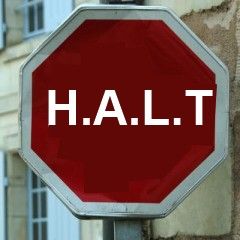
Explaining “the HALT method” for decision-making:

Brennan Manning died last year, and he is probably best known for writing the Ragamuffin Gospel. He accumulated a lot of wisdom through life, but it didn’t come cheap. Poor choices, wrong turns, and hard lessons molded him, eventually, into a person of great compassion and grace–a sage for the poor in spirit and those smart enough to listen. Many sought him out for his wisdom.

When Manning came into recovery as an alcoholic he learned a buzzword from AA (Alcoholics Anonymous). AA folks use it as a method and smart tool to create greater awareness in those vulnerable to slipping back into alcohol abuse.

• They stay on the lookout for four qualities that make them susceptible to relapse and are encouraged to seek help when they identify them occurring in their life. Before they take a sip they look for the signs and call for backup.

halt

If H.A.L.T., then halt.

Regular internal check for these:

H – Hungry (not just for food, but a longing in general)

A – Angry (or stressed, or frustrated)

L – Lonely (or rejected, or left out, feeling alone in the world)

T – Tired (often tired from helping others or being otherwise overcommitted)

We all need to cultivate an awareness of our vulnerabilities to avoid a slide into poor choices, creative slumps, or dangerous behavior.

Sometimes we don’t even realize our feelings while we are having them or how we are trying to soothe our selves.

Let’s develop the awareness to halt and take an internal inventory or seek help when we get run down, over-extended, or when we find ourselves feeling in some way hungry, angry, lonely, or tired.

 It is awareness which is at the heart of any ingenious creative pursuit, meaningful transformation or spiritual growth.


NEW next week (May 27)…A great interview with my friend, Emily Miller (writer and journalist for the Chicago Sun-Times and regular contributor to Relevant Magazine).

JUNE 3rd, comes an interview with expert creative, Daniel J. Lewis!


Please take part in this anonymous 30-second listener-survey so I can continue to produce the show.

Spark My Muse

C.S. Lewis on longing and friendship

A few tidbits today from a greater mind than mine by a thousand or more:

C.S. Lewis.

jacklewis

Jack, as his friends called him, lived and wrote with an authenticity that made courageously interacting with the most painful and potent stuff of life an ordinary occurrence.

He loved deeply, he thought deeply, he wrote deeply, he suffered deeply. All these things, love, joy, friendship, sacrifice, loss, and longing were the topics of his work.

A heavyweight intellectual with the rare kind of genius to write concisely and accessibly to anyone, he never shied away from the messy parts of life–no matter who the audience. He might be most famous for his children’s fiction, but his poetry, literary criticism, apologetics, and other works reveal him as a polymath and literary giant. Thanks to the recent Hollywood versions of Narnia movies (which ardent C.S. Lewis fans find grossly wanting) ave created a renewed interest in Lewis making him more widely read now than he was in his own lifetime.

What made the man?

Tragedies cultivated a pensive and sensitive aspect of Leiws that complimented an agile, imaginative, and sharp mind.

Perhaps the deepest wound happened at age 9 when he lost his mother in death. His father was emotionally distant and sent him off to a series of boarding schools–which he deplored. The isolation and grief seemed to create a “heart-wound” from which he suffered his whole life; and from which he found solace in the hope of heaven and in the embrace of friendship.

Author Anthony Burgess wrote that “Lewis is the ideal persuader for the half-convinced, for the good man who would like to be a Christian but finds his intellect getting in the way.” (*source)

But, not at first.

First, the pain made him a committed and intellectual atheist at age 14. Despite his choice, Lewis still wrestled with what most creators and artists do, spiritually, as his journal from that time reveals:

“If I find in myself a desire which no experience in this world can satisfy, the most probable explanation is that I was made for another world.”

Later, Jack would reconcile these longings more throughly with theism. (An acceptance of God as Creator.)

Subsequently, he found Jesus Christ the fitting Savior and Redeemer of the story–which is life and human experience. The Savior myths of ancient times and other cultures he said evidenced that the story of God and Jesus was a “true myth” reflected in meta-truth and narrative intwined into the cultural fabric and story of (nearly) every civilization.

He continued to explore this idea of desire and longing–from which any one with an artistic temprament can take confort:

“In speaking of this desire for our own far off country, which we find in ourselves even now, I feel a certain shyness. I am almost committing an indecency.


I am trying to rip open the inconsolable secret in each one of you—the secret which hurts so much that you take your revenge on it by calling it names like Nostalgia and Romanticism and Adolescence; the secret also which pierces with such sweetness that when, in very intimate conversation, the mention of it becomes imminent, we grow awkward and affect to laugh at ourselves; the secret we cannot hide and cannot tell, though we desire to do both.


We cannot tell it because it is a desire for something that has never actually appeared in our experience. We cannot hide it because our experience is constantly suggesting it, and we betray ourselves like lovers at the mention of a name. Our commonest expedient is to call it beauty and behave as if that had settled the matter.


Wordsworth’s expedient was to identify it with certain moments in his own past. But all this is a cheat. If Wordsworth had gone back to those moments in the past, he would not have found the thing itself, but only the reminder of it; what he remembered would turn out to be itself a remembering.


The books or the music in which we thought the beauty was located will betray us if we trust to them; it was not in them, it only came through them, and what came through them was longing.


These things—the beauty, the memory of our own past—are good images of what we really desire; but if they are mistaken for the thing itself they turn into dumb idols, breaking the hearts of their worshipers.


For they are not the thing itself; they are only the scent of a flower we have not found, the echo of a tune we have not heard, news from a country we have never yet visited.”


How beautifully he captures longing!

For Lewis, camaraderie, fellowship, friendship, and love brought light and healing to his heart and his world. Through them he remained grounded and prolific.

Lewis on friendship:

In a circle of true Friends each man is simply what he is: stands for nothing but himself. No one cares twopence about anyone else’s family, profession, class, income, race, or previous history.


Of course you will get to know about most of these in the end. But casually. They will come out bit by bit, to furnish an illustration or an analogy, to serve as pegs for an anecdote; never for their own sake. That is the kingliness of Friendship. We meet like sovereign princes of independent states, abroad, on neutral ground, freed from our contexts.


This love (essentially) ignores not only our physical bodies but that whole embodiment which consists of our family, job, past and connections. At home, besides being Peter or Jane, we also bear a general character; husband or wife, brother or sister, chief, colleague, or subordinate. Not among our Friends. It is an affair of disentangled, or stripped, minds. Eros will have naked bodies; Friendship naked personalities.


Hence (if you will not misunderstand me) the exquisite arbitrariness and irresponsibility of this love. I have no duty to be anyone’s Friend and no man in the world has a duty to be mine. No claims, no shadow of necessity. Friendship is unnecessary, like philosophy, like art, like the universe itself… It has no survival value; rather it is one of those things which gave value to survival.

Finding Your Purpose: The WISP method (STEP III: “S”)

So, I’ve surprised you with 2 untypical ways to find purpose in your life.

Here (Step 1) and Here (Step 2)

Hopefully, by now you’ve done homework and feel like you are progressing in new ways.

(I’d love to hear about it! Send me a note.)

Now we are on STEP 3

“S”

Service

This one may make little sense to you.

You may think,

“Really? That sounds backwards. I don’t know my purpose yet. I’ll try service once I get that figured out, duh.”

It’s not as backwards as you think.

(Creative Commons photo)

What will appeal to us in terms of service is often closely tied to our talents, gifts, and greater purpose.

Here’s an example:

When my kids were very little I made a point of helping my friends prepare for a big, yearly program. Instead of being fulfilling, it was frustrating and felt futile. I realized that my skills and passions were better served elsewhere. This eventually lead to many other types of service that tapped into my greater purpose and held greater meaning for me.

In the beginning, what drew me to help out was a sense of friendship, community, and desire to love and minister to others–to be part of something greater than myself. Those were all things I kept seeking. What I left behind were projects that could miss the forrest for the trees. The experience helped me know when projects were too detail-oriented to be optimally useful in a greater way, for my preferences.

Would I have been able to narrow things down for myself without making this (seeming) mistake? No. And it wasn’t a mistake to help, it was a clarifying exercise.

Would I have been able to decipher what types of service aren’t a good fit for me without this experience? Unlikely.


In serving, something else happens. It’s big and you’ll see the pattern once I mention it:

In losing ourselves we are found.

That means by taking ourselves out of the middle, we can see and choose better and more easily.

(It doesn’t mean thinking less of ourselves, but thinking of ourselves less–by design. Thus, we more expertly “stumble” on to bigger insights.)


In a way, you don’t find your purpose at all, it finds you.

From my perspective, finding God works the same way. You are only lost to yourself, not to God. So you don’t so much “find him” nor does he “find” you. Instead you wake up.

The same holds true for finding your purpose.

We tend to assume, just by default, that finding our purpose must start and end with us. Not so.

Just like Worship, service makes finding your purpose far easier because it becomes a revelatory process. Finding your purpose, like finding happiness, comes as a byproduct of doing other things.


So where can you start with meaningful service that will help you find your purpose?

Here are some categories and qualifiers to explore:

If one stands out as more meaningful, or ignites your passions (which is directly connected to your purpose), try that first. Check with your church, your community, your local schools and organizations, local charities, or just asking around to see what available or sounds like a good fit.

What ever it is, do something. The key on this step in ACTION followed by reflection.

If you are already serving, reevaluate it. It is leading you to a greater purpose or holding you back?

(If you are overly involved in service, then it’s time to scale back.)


HOMEWORK – take some field notes on the following questions:

• Do you like Creating? (What do you like and how do you like to do it?)

• Do you like helping and being useful? In what ways?

•Using your body more than your mind to help out?

OR

Using your mind to help more than your body?
(At the end of the day, which feels more satisfying and why?)

• Do you like being the glue that holds people and projects together?

• Does helping behind the scenes feel meaningful?

• Do you like detail-oriented projects…

OR

Being the visionary that comes up with and starts the project?

• Do you like teaching? (If so, what about it appeals to you?)

• Do people in need ignite your passions?

What about your past service appealed to you and why?

(If you don’t have much past service to serve as a gauge, that’s your biggest obstacle. Start right away. You are much too “in the middle” of your world and you need a break from yourself.)


[You guesses it! This is handy-dandy notebook time! Write out your field notes from the questions above.]

Also consider:
What specific population do you feel drawn to serve?

(It’s okay to specialize and then turn away things that fall outside your scope. This refinement is usually helpful. However, once in a while change it up and serve outside your specific domain–it will surprise you by opening new doors or clarifying your purpose further.)

Types of Populations:
• elderly

• children

• poor

• students

• the needy

• peers

• 20-somethings

• new parents

• the forgotten populations (immigrants, incarcerated, homeless, mentally ill, etc.)

• who else?…


Assess how your TALENTS and SKILLS play into your past service decision.

• What sort of technological knowledge, special skill, unique experience, or centering insight makes certain kinds of service easier?

• What is your “backstory”? Your backstory tends to shift you toward you purpose.

The next step is “P”…come back soon.

Do you know anyone who’s struggling finding purpose, or feels “off-track”? Pass this along!