Esp 22: Why The Dark Night of the Soul is like Fight Club

Here’s a resource for you that is sure to give you a boost.
AND Your purchase will help me continue the show.

(Have you already read it or might you be feeling a bit more generous? Please use the donate button (in the left sidebar) to contribute to the the work here. Help me make awesome things for you each week. Thank you!)


Shownotes
Doug Jackson, Returning Guest and All-Star, Explains the 3 Stages of Spiritual Development and Dispels the Biggest Myths.

Do you know St John of the Cross?

What you don’t know could hurt you…but good news, you are now in for a treat!

Listen and get a fascinating perspective of the darkest places on the spiritual journey with your guide Professor Doug Jackson. See the show notes below!

DougJackson

3:00

Historic context of 16th Century Catholic Revival-Era Spanish Mystic, St John of the Cross

4:30

3 stages of spiritual development 

How do we know if we are making progress and what can we expect?

St John (1542-1591) provides a roadmap for night travel.st-john-of-the-cross-zurbaran-detail-featured-w740x493

The Beginner Stage
(The beginner loves God for the self’s sake. The beginners thinks, “What’s good for me.”)

John H Coe

Doug explains the Dark Night of the Soul, the important next stage of spiritual development, in keen and helpful detail.

7:00

God starts at the first stage (in a place of joy and thrill in God) and allows us delight in spiritual things and feed on “mother’s milk” spiritually.

Next, God helps us get used to our baby teeth by moving us to love God for God’s sake.

John of the Cross takes the 7 deadly sins and show how they can happen to us in a spiritual sense.

8:10

God is weening us away from nursing and from spiritual milk. Like a baby, we may misunderstand and feel unloved or unnoticed, at first.

9:00

Commodified is the Dark Night of the Soul in Amercian Evangelicalism. The phrase itself is often used inexactly.

It’s not feeling sad or a string of bad things have happened for which we feel upset and confused.

BUT—It is that without cause we feel God has abandon us.

It is not a loss of faith, nor not depression, nor a felt distance because of sin.

It was also an analysis of depression 400 years before Freud! 

11:00

God withdraws sensible (sensory, felt) affects. The dark night of the senses. (first phase).

12:30

Maybe it feels like prayers are bouncing off the ceiling. Maybe it feels that songs or sermons that had made an affect no longer do. This sense of loss will be different for each person.

13:30

Essentially, the delight in God disappears.

13:00

Mistakenly, we often may try to shock people back into spiritual infancy with a method, tactic, or suggestion that seems like it might cause feeling once again. (like a book, a conference, a service, etc)

14:10

The spiritual advice from John is to not abandon your spiritual practices (like prayer, fellowship, meditation, service, etc) continue to obey God and carry on until you pass through the night. They won’t be fun, but you continue for God’s sake, not your own.

Then you can come out on the other side to the stage of the Proficient. (Though the stages are actually more porous.)

15:00

The 2nd stage is where John says most of us get and hardly proceed from.

2nd dark night, is rare, and is horrible and includes a bewilderment and even a loss of faith in God and one comes out with a much richer deeper faith and far more settled and fuller understanding of God.

John Coe using 1 John 2:12-14 explains the stages as well.

18:00

John of the Cross found this understanding through terrible suffering and imprisonment and he saw the spiritual connection.

19:30

In the Dark Night of the Soul, spiritual answers are obscured and things are hidden from view.

Walking by faith and not sight.

22:00

If you can’t find the answers it doesn’t mean that something went wrong, it’s just that you can see right now. There will be a lack of certainty.

22:30

Stick with the basics in the dark night.

23:30

In the dark night we aren’t doubting our Faith, or God, but but we are doubting our understanding of God and our Faith.

The call is to obey God and persist in our ways as before. Eventually a dawn will come.

23:00

In this stage, we jettison things that are not core, central and true and come to understand God in a better way.

BE WARNED: Others may feel anxious to get you back in to where you were.

24:00

Backsliding is not the same thing as a Dark Night experience. The Dark Night is progression.

24:30

Prophets in the OT go through the dark night times.

25:00

Using a different lens to see what is already there.

26:00

Examples:

Elijah after Mt Carmel

Apostle Paul

Job

Jesus (wilderness and Gethsemane)

Jesus “learned obedience” and the the will of God was not pleasant

We all go through these types of dark nights


28:00

John of the Cross’s work was (and is) written for [spiritual] guides (leaders) so they can recognize what is happening and to know what not to do.

30:00

Some mystical-style theologians have been hijacked and grafted into a different (sometimes New Age) model of how the reality is ( i.e. “divided self”.)

30:30

The Devil – So what about the Devil which is a prominent feature in the writings?

A CAUTION:

John takes the readers’ Christian theology for already granted. The basic Christian theology was assumed because that was the background and beliefs of his audience.

32:00

Doug answers…Devil with a Big “D” questions. How do we come to understand John and what he is saying, if it is different than our understanding of The Devil and the spiritual world?

Don’t rehabilitate [John], or superimpose our ideas on his work.

Don’t judge or put parts on trial for the embarrassing and difficult sections of St John of the Cross.

34:30

Approach the text thus: “Eat the meat of the fish not the bones”

35:00

If the language bothers you, then let it lie fallow and see what is going on in your own heart as you read.

35:30

We can learn from old text.

36:00

On intellectual honesty and intellectual humility

37:00

On why the devotional classics become that way.

37:30

On the reading of old books (C.S. Lewis) (click to read)

We have different blind spots now. Different mistakes in different times.

38:30

Our cultural and worldview will effect our beliefs.

39:00

How do we get through the Dark Night?

It is up to God as a Grace. Our only job is to remain faithful.

Father Francis Kelly Nemeck

41:00

The promise is (found in Scripture and from those who’ve gone ahead of us in the Faith) that we come out (into dawn) and see the value of what we went through.

God says to Job: I’m God and you are not.

Job says, “Now I have seen you. I spoke out of turn.”

42:00

A word of hope for those in the dark night.

1. Those in the dark night bless those around them and their pride does not effect this because of the Night itself. We are spiritual protected.

43:00

In the Dark Night we don’t get to be proud of our humility.

Be faithful know that God is using you and wait it out.

43:30

Modern example Mother Teresa. She lived most of her life with a sense of abandonment by God.

“If I ever become a Saint I will be a Saint of Darkness, facing the dark to guide souls to the light.”

44:00

People were drawn to her service and work for God even though she felt God’s silence.

45:00

On her critics who say she stopped believing in God.

Christopher Hitchens wrote slanderously about her and others in his book “The Missionary Position”. He said she did have the courage to admit publicly that she didn’t believe in God and never had.

46:00

Mother Teresa–her fruit shows otherwise (it’s sow belief and faithfulness).

Apostasy is a deliberate walking away from God which is a danger of misunderstanding the Dark Night. This is why trained and wise spiritual guides are essential.

47:00

C.S. Lewis character Screwtape urges: “Use the word “phase” to tell him he had it all wrong”

In a genuine Dark Night, we may think we have abandon God or want to and then find ourselves incapable of it.

48:00

Doubt in God is like holding a volleyball underwater with just one hand and senses all the force and then thinking there is no volleyball because it cannot be seen.

“We aren’t working without a net and we won’t fall out of the arms of God.”

49:00

If you are in the Dark Night…(it helps) remembering “it’s a thing, a documented thing”.

49:30

Walking in the footsteps of those who’ve gone before.

51:00

What to do if you are in the throes of it all. best advice.

Richard Foster’s advice in the Celebration of Discipline. The chapter on solitude.

Don’t try to explain this to people when you are in it.

(It’s like Fight Club) “The first rule of Fight Club is you don’t talk about fight club”

Most people will not get it. It can hurt our spiritual reputation. God is drawing us into obedience and faith in the absence of feeling. We carry on

Spiritual Director or guide is very important.

“The Dark Night of the Soul” (click to get it free)

“The Way of Spiritual Direction”

“The Spiritual Journey: Crucial Thinking and Stages of Adult Spiritual Genesis”

Henri Nouwen “The Way of the Heart”

55:00

Protestantism running thin in certain areas.

Psychology tainted some spiritual experience as pathology and than co-opted with modern Christianity.

57:00

Baptists were not systematic theologians early on because of the persecution from the Mother Church (in Rome).

58:00

Puritan writers like Jonathan Edwards take God as Physician of the Soul very seriously.

59:00

The one sermon that did in Jonathan Edwards in our time.

“The Religious Affections” To teach that the Great Awakening was just an emotional experience or demonic experience. He writes on how to understand what is of God.


60:02

On taking your time understanding the Dark Night. God is trying to bring us into greater maturity and Christ likeness.


Have you ever gone through a Dark Night of the Soul?
If you’ve reached the dawn, what was strengthen or changed in you?

Blessings in your night travels. If you aren’t in a Dark Night, it’s coming. Stay Calm and Carry on.

If you have any questions or you would like to drop me a line about what you are going through, please use the contact page. A helpful (worldwide) listing to find qualified guides is here.

 

Episode 20 – Puncturing the Illusions of our own Ableism and Flawed Ideas of Normal (with Tom Reynolds) part 1

Tom Reynolds
Tom Reynolds, PhD


Shownotes: PART I
A conversation (in 2 parts) with

the author of Vulnerable Communion: A Theology of Disability and Hospitality, by practical theologian Tom Reynolds


Bio:
Tom joined the Emmanuel College (part of the University of Toronto) faculty in 2007. He is committed to an interdisciplinary, practical, and relational vision of theology, his teaching and research address a range of topics related to constructive theology (particularly the doctrine of God and theological anthropology), theological method, intercultural and interfaith engagements, contextual theologies and globalization, philosophical theology, disability studies, and the thought and influence of Friedrich Schleiermacher.

His recent Articles

Email: tom.reynolds@utoronto.ca

MIN 4:00

Incorporating the theology of disability into his work training pastors at Emmanuel Seminary, because theology is personal, and not disconnected from the real world concerns of the church and people living their lives.

4:30

About his son Chris sparking his interest and work in the theology of disability.

5:30 Learning that disability isn’t a problem to figure out, but rather it’s about a person who I love and live with, and care with and for, which radically reoriented my perspective on theology.

5:50

Disability and God’s Providence

(Questioning does God “cause” disability as a curse or opportunity for healing…or a kind of moral lesson…)

6:30

His son exploded the theological categories (and assumptions) pertain to Providence…making everything confusing and needing to be re-thought.

7:00

What is abnormal? What is “faulty” humanity?

Amos Yong, Hans Reinders, John Swinton writing on the topic too.


8:15

Tom details the new book on the Theology of Care which builds on the first book.

8:40

Some churches stress Cure over Care in terms of disability.

8:50

(Lisa) My visit to a church where the leadership was interested in healing my son from his non normative experience of the world.

10:00

The range of responses churches have when encountering people with disabilities.

The  church’s “urge to cure” is better than outright exclusion, which plenty of families have encountered.

11:00

It comes from the the idea of remaking and fixing someone in a way that is more comfortable for non disable people and normalcy (what they consider normal). Not helpful or Christian.

12:00

About the church that didn’t want his son as a disruption and a church that did receive them.

13:00

“How can we help you?” was water for his parched soul. How the church accepted and welcomed the uniqueness of his son.

14:15

Hospitality vs. a narrow view of what is preferred.

15:00

The messiness of various kinds of people, in general, means we have to expand our view of grace.

15:30

Who gets to be a full-fledge member of the church community?

and the “mascot syndrome” for those with disabilities.

16:30 – 17:50

Levels and types of responses:

• Tolerate disabled, but they do not get to be a true part of the church.

• “Inclusion” sometimes means means the the “outsiders” get invites to the inside group based on the good graces of the in group, but are still treated as problems to be solved, or people that are to receive the gestures of charity from others (people for whom things are “done for (them”)”. Doing for instead of “being with”.

18:00

What is access? In is not just accommodations (i.e. ramps and special bathrooms) and alterations but ongoing…

Faith communities may be not expecting and not ready to receive those with disabilities.

18:30

It’s not an issue about outsiders, because disability extend to a broad range of issues, both visible and not visible, including mental health challenges that are already there.

18:50

Thinking of the word “BELONGING”

as in “to be longed for when you aren’t there in the fullest sense.”

John Swinton and belonging

19:40

Jean Vanier “In giving and receiving do we really thrive as people”

20:30

Unconscious bias that includes “fear of the stranger” and “fear of the stranger within”.

21:00

We fear weakness and vulnerability.

21:30

Before “mainstream”…the stigma of “retard”…and fearing and disposing weakness.

22:20

Nathan means gift. (Lisa) I learned that I had to recognize weaknesses (shortcomings) in myself the I saw reflected in my son…and communities can do the same type of thing unconsciously.

23:00

“The encounter with disability punctures the illusions of what we think of as our own strengths.”

23:50

The journey with a child with disabilities is isolating.

25:30

Societal epidemic that fears being vulnerable or perceived as weak or unable to perform in ways that are considered valuable by society.

26:00

We have to see what are myths about autonomy, independence, and productivity where are assume we are self-reliant and these qualities are prized so highly. “Able-ism” (The idea that being able in body and mind is normal and most vital which serves as the lens by which we see and judge the world and others outside those parameters as faulty.)

27:00

Tom’s latest work called “A spirituality of attentiveness”. Christianity: St Paul’s strength in weakness serves as a prophetic witness against a society that prizes the strong as the main thing of value. 1 Corinthinians pretense of strength undercuts our ideas of grace)

29:20

We are all only temporarily-abled. (Lisa).

31:00

On hearing “You must be so blessed to have a disabled person as a teacher.” Is this sometimes a reframing of the situation that spins the situation to be more palatable? A glossing with spiritual truths and making it about spiritual growth.

31:20

Instead, Chris’s life seeks its own flourishes, and he may at times function as a teacher.

33:00

Thoughts on intellectual ability (or inability) and belief in terms of Salvation.

God’s works God’s own path in different ways and in different capacities with people. This undercuts my arrogance (as a theologian), so I don’t think I can so easily map it out definitively and universal for all people in all places.

34:00

His son’s atheism (who is the God he doesn’t believe in)…and how that challenges our presuppositions about God.

34:50

“It is in the kind of relationships of mutual belonging that the full image of God is borne out.”

35:30

(Lisa) To my son I said, “when you see someone who is loving you, you are seeing God.”

(Lisa) On how I changed from thinking “right belief” as the way to understand God was central. Our intellectualizing what God has done is not salvific.

38:00

Martin Luther’s theology of the Cross:

The pretense that we know exactly where God is and how God works. Where God is most hidden is where God is most vividly revealed in saving ways.

38:30

“Who I am to declare that God’s grace only works in some ways? and the God’s capacity and God’s own mystery is limited to what I would deem and my community would deem adequate.”

39:30

What the practical theology of disability tells us about Grace with God and relationships with others.

40:00

“The longer I live and work as a theologian the more I realize the limitations of theology and the true infinite mysteries of God.”

Jesus was disruptive to religious pretense and suppositions. “You say this..but I say this…”

Theodicy – The question of why does God allow suffering and how should we think about suffering.

How Tom, as a theologian, answers the question,
“Why would a sovereign God allow a person to be born disable and encounter such suffering?” (This is great!)

The best is yet to come! Come back for part II next week.

Will you help me meet my goal of raising $100.00 in August to keep Spark My Muse going? Use the Donate button on the left sidebar. Thank you for being a big ball of love!

Episode 18 – Nicole Unice is “Brave Enough” AND so are you!

Nicole Unice

BIO:
Nicole Unice is on staff at Hope Church in Richmond, Virginia, and the author of the breakout book: “She’s Got Issues” which she wrote from her counseling and ministry experiences. The book produced and encouraged a refreshing and radical honesty that she’s built on in her new book “Brave Enough”.

Enjoy the Shownotes and links below and please share this with friends that you know CAN be “Brave Enough“. Thanks for listening!

#GetBraveEnough

xo

~Lisa

P.S. Would you like to get a special, cozy Spark My Muse t-shirt?

Let me know HERE.
bravenough


Get  Brave Enough or find out more here:

Like to listen instead of reading? Get the AUDIO book here.


Shownotes – Episode 18 Nicole Unice is honest, enthusiastic, and “Brave Enough”, so you can be too.


MIN 1:10

Nicole on staff at Hope Church

on the Richmond VA place and new midtown location.


1:30

Nicole’s podcasting experience (the Becoming Podcast) doing hundreds of episodes with her pastor doing 15 minutes shows for commuters.

Lisa asks: Is “campus” a Christian code word for mega church?

2:40

How she grew with Hope Church for 18 years, as they started out small in an elementary school “cafetorium”.

3;50

The “Youth Lodge” plans and the unique setting with wetlands and hills.

5:10

On the importance of Beauty, Setting, and Art in architecture and church building planning to evoke the imagination, inspire awe, and connect with the heart.

6:40

Collaborative workspace, and place where kids can do their homework and where people can enjoy the time away in a beautiful setting.

7:40

“artist come through the side door of the soul and preachers come through the front door.”

8:50

The history of the church and Christian tradition is one where the Church is source of beauty, wonder and connected to art because God is a the Creator.

9:40

Her first book: She’s Got Issues

6 main issues women (and men) face that can be a hinderance.

A rich relationship with God can come to a dead end as the ways we do life stop working.

12:00

How was it received? The #1 thing Nicole heard was, “You’re so honest.”

Why would honesty be such a revolution in Christianity?

12:40

She leaned into that for her next book “Brave Enough”

13:00

The story of how she got the title for the book:

To the question, “Do you think you can be brave?” Lucy Pevensie in the Chronicles of Narnia says, “I think I can be brave enough.”

14:35

Few women will self-identify as brave. [and not many men will either]

“After we identify the hinderances, what does it look like to walk forward in freedom?”

15:00

Brave Enough is about Grace and its effects, inside and in action.

15:40

Nicole answering the question: Do men have the same problems in this area?

16:00

“Women hearing teaching from women is like hearing in your first language.”

16:30

Ways Nicole leads and teaches men.

17:00

on how women have to translate teaching from men into their “language” and context.

18:00

On how, similarly, Brené Brown was challenged (by a man) to include men in her writing and teaching. (Lisa)

18:40

How men and women have similar vulnerabilities though they might deal with them differently.

19:40

“up speak” tones in language in women and men revealing different insecurities. (Lisa)

21:00

Nuggets from the Brave Enough book:

How the ingredients mixed into something she didn’t expect. It follows a narrative “arch of the heart”. How we can be full and free and confident in life.

22:30

on why (inner) freedom is illusive for men and women.

On “Fake Grace” in our head. (the excuses we make or how we blame others). Inviting God/Jesus into those places.

24:10

We all (default) and go back to rules and laws and how to short circuit that pattern.

It’s about resetting the heart with a new spiritual reality.

25:00

Radical honesty about our ugly parts inside the heart.

25:30

Nicole’s Parable: The violently stopping of the elevator door…(and how it relates to our soul).

26:10

Open ourselves to God’s Presence and healing.

26:10

(Lisa) God uses what bothers us about other people is a mirror of what we don’t like in ourselves.

27:20

How our baggage works to impede our progress.

Brave Enough includes major parts on forgiveness

28:00

God’s breathing on us and giving us the mission of forgiveness, first.

(Click to read the reference John 20:19-23)

28:30

When we keep living out of a wounded place.

29:10

How we continue categorizing our experiences to support our false and faulty premises and hypothesis about ourselves.

29:30

Questioning what is really true about ourselves (and the mental “tapes” we play).

33:20

God gives us opportunities to practices forgiveness every single day, often in small ways in the relationships and event of regular life.

33:40

If we can’t be gracious to ourselves we can’t be gracious with others.

34:20

The economy of our heart: if we forgive little then we love little.

36:30

(Nicole asks Lisa) “What have you learned in doing podcasting?”

38:30

We have the chance to never stop growing and transforming and God never gives up on us.

39:20

Brave Enough is also an AUDIO book. Find it here.


Did you like the show?

Please share it or otherwise support Spark My Muse!

Want to extend the good times and answer the question of the day?

What “bad/negative tape” do you have playing in your head most often?


Episode 13 – “We cannot encapsulate God in our Theology” guest Doug Jackson

If you’ve listened to the show…
Please click our audience survey button so we can better understand who’s listening.
(It takes about 1 minute to complete and it’s 100% anonymous.)
Spark My Muse
Thank you!

Shownotes for Episode 13  Wine lovers have God to thank + guest Doug Jackson


First, I want to feature the book Doug and I wrote …

entitled Dog in the Gap because of a C.S. Lewis quote “Man and his dog close a gap in the universe”.


And there’s a BONUS EDITION with lots of goodies!
Read a sample here!


Will you fan the spark?

Inspired by how musician Amanda Palmer put it, “Don’t make people pay [for art]. Let them,” I am altering how Spark My Muse stays alive…from bottom to top (literally).

How does it work?

It’s up to you. I need at least $75 per episode to keep it solvent.
Every little bit helps!
So, I invite you to just listen, read, and give as you can.


Thank you! Enjoy the show!

With love,

~Lisa

WINE SEGMENT:

Who do we have to thank for wine?

God and the Church, actually.

Wine lovers in Western civilization have the Church in Europe (and the Roman Empire and the Holy Roman Empire–which was neither holy nor Roman ) to thank for the large-scale production, the prevalence and the excellence of wine!

Why? 

Because liturgy involving wine for communion was central to Christian religious practice. Wine was ingested as the saving holy blood of Christ (and bread as the holy body of Christ), usually each and every day. The sacraments of Communion served as saving grace afforded to the Church.

As Roman Empire became officially a Christian Empire (circa 313 CE) many vineyards had to be planted, properly cultivated, and harvested. Grapes had to be made into a lot of to support the daily practice of communion throughout the Empire.

Communion served as wine was the norm among Christians world-wide until recently–in the era of pasteurization. To keep juice from grapes in a state were they would not ferment meant it had to be sufficiently boiled so the natural yeast would die. 

Vehemently opposed to alcohol, Thomas Bramwell Welch, a physician, dentist, and Methodist pastor from Vineyard, New Jersey, figured out the process in 1869 with Concord grapes. Most churches did not accept the switch as proper and stayed with wine.

The juice later became more popular during Victorian era because of prominent values of abstinence. A shift then began in the U.S. that made grape juice the main communion beverage (at least among certain Protestants sects).

Several hundred vineyards operating in Europe today can trace their history to monastic origins.

In the 9th-15th centuries almost 1,000 monasteries dotted Europe. They were centers of education, stability, and technical innovation. Monks and nuns could read and write–this was quite uncommon then.

Monasteries cared for the sick, helped the poor, created places of education, and invented Universities. They could not fund all this through donations. Surplus wine was sold to finance ministry work (and also beer, fruit brandies, and cheese, among many other things..even prayers and Salvation ..which–in hindsight–appears to have been a mistake ) .

So, basically, thank God (and many monks) for wine!


Sparking your muse

 Enjoy the fantastic chat with Doug Jackson!

Doug-Jackson

Douglas Jackson, D.Min.
Director of the Logsdon Seminary Graduate Program

Doug Jackson came to SCS in 2006, after serving as pastor of Second Baptist Church, Corpus Christi, since 1993. In addition to teaching courses, Dr. Jackson functions as a liaison between Logsdon Seminary and local churches in Corpus Christi. His areas of specialization include spiritual formation and pastoral ministry. Dr. Jackson has published and presented several articles and essays in religious and literary venues, including articles and lectures on the life and writings of C.S. Lewis.
• D.Min. – Truett Seminary (2006)
• M.Div. – Southwestern Baptist Theological Seminary (1985)
• B.A. – English Literature, Grand Canyon College (1982)

His blog is here.


Interview / chat notes:


MIN 8:00
on Doug preparing for a his Fall class.

A resource he is using by NT Wright – “The new perspective on Paul”
The covenant people God has saved.

8:50
Reformers and the necessary correction in contemporary times.

9:00
Confronting individualism
and thoughts on human flourishing.

9:50
on the idea of being “spiritual but not religious”

10:30
on his work about CS Lewis

Mere Christianity

11:00
The importance of imagination for understanding that isn’t covered by rationalism.

12:30
on his Oxford lecture
Owen Barfield an influential life-long friend of CS Lewis

Another lecture on Walter Miller – A Canticle for Leibowitz
Apologetic self-proclaimed validity on the rational scheme of knowing.

“Scholarship is about knowing more and more about less and less so that eventually you know everything about nothing.”

14:30
James Sire

15:70
Malcolm Guite https://www.facebook.com/malcolm.guite
Chaplain of Gerton college and Cambridge
“Faith Hope and Poetry”

He covers the imagination as a way of knowing (an epistemology).

Holly Ordway
Houston Baptist University
“Not God’s Type”

Her 2-track movement toward conversion

18:00
Brainpickings.com Maria Popova (an admitted secular atheist on a continual spiritual search)

19:00
on Spiritual atheism

….if we come up with a system that covers everything (Christians and Atheists alike)…

“Humans are sensitive and emotionally vulnerable to a wasteful degree evolutionarily speaking…highly valuing the arts.” (Lisa)

Christ in the Desert Benedictine Monk and Abbot
Philip Lawrence, New Mexico
…slipping in and out of atheism….

21:30
HG Wells, and the fundamentalist reaction to him and others of his ilk.

on how science and religious circles have had an absolute unwillingness to be in one another presence and (have not wanted) to admit any weaknesses and (instead) just shout louder.

22:20

“The best apologetics can do is make Christianity credible and I don’t think it can make it inevitable.”


22:30 “Any belief in any ideal is still a leap of faith for anyone… like Justice, Love, Hope…” (Lisa)

23:30
on How people appeal to a standard outside themselves. (CS Lewis)

24:00
Theories of “survival behavior value” for Morality and Justice kicks the can. or it lands on simple absurdity and meaninglessness where suicide becomes a valid option.

25:00

Doug answering the question….”Is fundamentalism evolving”?

26:00
Richard Foster’s classic over 50 years old “Celebration of Discipline”

27:20
A story of a crucial pivot point for Doug.

28:20
How the psalmists had to cry out to God when the answers didn’t suffice any longer. For us, this is a return more than a departure.”

“I have gained the gift of being able to respect other traditions and admire things they bring us, but I talk to people across that spectrum that have that experience.”

29:30

“We go from trusting our denominational address or theology address to trusting Christ but it doesn’t mean an abandonment of it. Choosing a room in the same house to live in.”

30:10
Spiritual disciplines most meaningful to him:
On solitude and privacy (the difference). Henri Nouwen explains the difference.
 Henri Nouwen explains in “Out of Solitude” 

Doug: Solitude is for battle. Privacy is to be alone.

31:00
Demons come in our solitude (Desert Fathers). The outcome is awareness and purification.

32:00
Wanting “the listening heart” (what Solomon really asked God for).
on the importance of listening to God…

33:30
My Stockholm syndrome at parties. (Lisa)

34:00

“(My) Inability to be with people was driven by a failure to have a real self.”

34:30
“you are nearer to me than my own self.” Augustine

Doug realized:

“My real Self can’t be with people because it’s threatened by them, because they’re going to colonize my Self and going to make me into something I’m not. As opposed to having a real Self that can listen because God is protecting that Self.”

Father Francis Kelly Nemeck wrote
The way of Spiritual Direction (his director)
…Doug and I discuss Detachment and Holy Indifference…

39:00
St John of the Cross
(Exploring the spiritually obscured times and darker emotions.)

“the nada” (God is “no thing” the silence before God

40:00
…on staying in the problems and not panicking.

41:00
…on the crucial lesson from his mom that revealed his theology

44:30
(unknowing) Apophetic theology

“John of the Cross didn’t want that we should abandon the metaphors but move through them.”

45:00

“We cannot encapsulate God in our Theology.”

(which is terrifying but life-giving)

46:00
[GOOD NEWS]
Further exploration in a future episode of John of the Cross with Doug coming soon!


If you enjoyed the show please give it a stellar review on iTunes here!

Watch for new episodes each Hump Day (Wednesday).

Episode 9 – Wine: moderation vs. medication (The famous HALT method)

Shownotes:
Spark My Muse
Episode 9 – Wine: moderation vs. medication (The famous HALT method)


This is a surprise “mid-week” episode. This show normally goes live each Wednesday. Episode 10 and 11 are longer special interview episodes.

Episode 10 (airing May 27th) Emily Miller writer and journalist for the Chicago Sun-Times and Relevant Magazine

Episode 11 (airing June 3rd) Daniel J. Lewis prolific creator of an entire network of podcast programs, including nationally-awarded shows on how to podcast, comedy, and the #1 rating discussion show for ABC’s series “Once Upon a Time”.

Check back for those!


This episode was brought to you by “The Daily Sharpening Ritual”–The perfect way to supercharge and renew personal awareness in your life.
The simple but effective worksheet was designed to create extra awareness and transformative improvement with minimal planning and effort.
It takes just 3-5 minutes each morning and at night.
• You can see big changes for the better in only 5 days. Give it a test try, you have nothing to lose.
(simply print out 5 copies and follow-through!)


While tipping is appreciated…these are yours to use for free.
Choose either or both options and see which one you like best:

• The SHARPENING Ritual 

• The SHARPENING Ritual
(PRAYER-centered VERSION)


Wine segment

How much wine is considered “drinking in moderation”?

• Rule of thumb: 2, 5oz glasses per day is moderate drinking, and no more than one drink per hour, or four drinks per occasion (like an all-day event like a picnic or wedding)

But if it’s hard to go a day without drinking wine (or wanting to), rethinking your relationship with wine is needed.

The show details some physical repercussions of over-consuming wine, and a practical way to build mindfulness.

• If you unsure that your consumption is healthy, jot down the feelings behind the desire to consume wine so it doesn’t master you.

• Wine can too-quickly be used to medicate ourselves, and this hurts our Souls. Be mindful. :)
(“Soul” meaning what it does in Hebrew: our whole-self, mental, spiritual, creative, relational, etc)


Sparking your muse

Featuring the book by Brennan Manning called, “The Wisdom of Tenderness”.

Explaining “the HALT method” for decision-making:

Brennan Manning died last year, and he is probably best known for writing the Ragamuffin Gospel. He accumulated a lot of wisdom through life, but it didn’t come cheap. Poor choices, wrong turns, and hard lessons molded him, eventually, into a person of great compassion and grace–a sage for the poor in spirit and those smart enough to listen. Many sought him out for his wisdom.

When Manning came into recovery as an alcoholic he learned a buzzword from AA (Alcoholics Anonymous). AA folks use it as a method and smart tool to create greater awareness in those vulnerable to slipping back into alcohol abuse.

• They stay on the lookout for four qualities that make them susceptible to relapse and are encouraged to seek help when they identify them occurring in their life. Before they take a sip they look for the signs and call for backup.

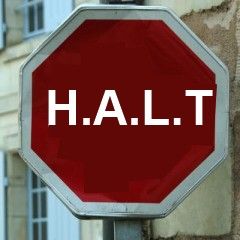
halt

If H.A.L.T., then halt.

Regular internal check for these:

H – Hungry (not just for food, but a longing in general)

A – Angry (or stressed, or frustrated)

L – Lonely (or rejected, or left out, feeling alone in the world)

T – Tired (often tired from helping others or being otherwise overcommitted)

We all need to cultivate an awareness of our vulnerabilities to avoid a slide into poor choices, creative slumps, or dangerous behavior.

Sometimes we don’t even realize our feelings while we are having them or how we are trying to soothe our selves.

Let’s develop the awareness to halt and take an internal inventory or seek help when we get run down, over-extended, or when we find ourselves feeling in some way hungry, angry, lonely, or tired.

 It is awareness which is at the heart of any ingenious creative pursuit, meaningful transformation or spiritual growth.


NEW next week (May 27)…A great interview with my friend, Emily Miller (writer and journalist for the Chicago Sun-Times and regular contributor to Relevant Magazine).

JUNE 3rd, comes an interview with expert creative, Daniel J. Lewis!


Please take part in this anonymous 30-second listener-survey so I can continue to produce the show.

Spark My Muse